Weaselskin: the man the valley named twice
A creek and a bridge both carry his name, and the documented record shows a Southern Ute farmer and horseman, not a chief.
The name the valley wrote down twice
Weasel Skin Creek enters the valley just north of Vallecito Reservoir; Weaselskin Bridge crosses the Animas about nine miles south of Durango, by Sunnyside Mesa. Two landmarks, forty miles apart, both named for one Southern Ute man. Most of what people “know” about him is a gold story. The documented record is quieter, and truer, so we start there.
Núuchi country
The Ute people — Núuchi — are among Colorado's oldest continuous residents, in these mountains long before the territory had a name. The Pine River and Vallecito corridor was travel-and-hunting country; the high parks and the river bottoms were used in their seasons.
Source: Southern Ute Indian Tribe, tribal history (southernute-nsn.gov/history).
The vise, 1873–1895
Within a single generation the Utes' hold on the San Juans was pried apart. The Brunot Agreement of 1873 stripped the mineral-rich mountains from the reservation. The Hunter Act of 1895 split the Southern Ute bands: the Weeminuche refused allotment and moved west to Towaoc, while the Mouache and Capote took individual allotments around Ignacio. This is the world Weaselskin lived in — farming an allotment on the Animas while the land around him was being surveyed into parcels.
Source: Southern Ute Indian Tribe history. (Weaselskin's own band is not documented, and we don't assign one.)
The documented family: an adobe house at La Posta
The earliest solid records are a handful of small items in the Durango Semi-Weekly Herald. They are written in the paternalistic voice of their time — that tone is itself historical evidence — but through it, an ordinary settled life is visible. In July 1908:
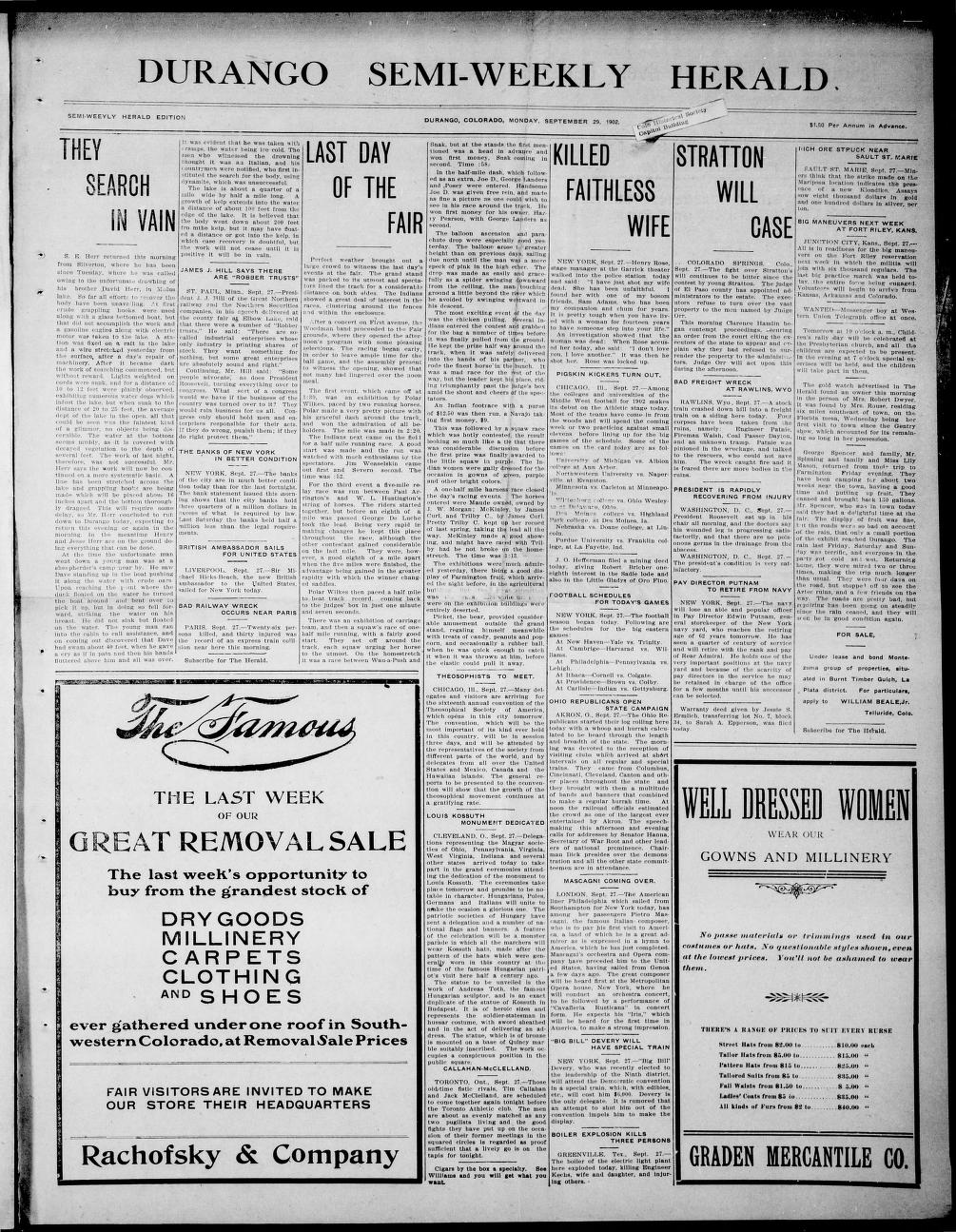
“Marcellino Weaselskin is in town from La Posta today. Mr. Weaselskin is a Ute, but the family long ago gave up living in a tepee. Weaselskin has lived for years in a 'dobe house on the river near La Posta.”
Durango Semi-Weekly Herald, July 20, 1908, p. 3
An adobe house, farming the Animas bottomland near La Posta — not the roaming figure of the later legend. One puzzle the record leaves open: this 1908 item names Marcellino Weaselskin, while the 1902 and 1910 items name Jim. Whether that's one man with a baptismal name and an Anglo one, or two men — father and son — we can't resolve from the sources, and we won't pretend to.
Jim Weaselskin, horseman
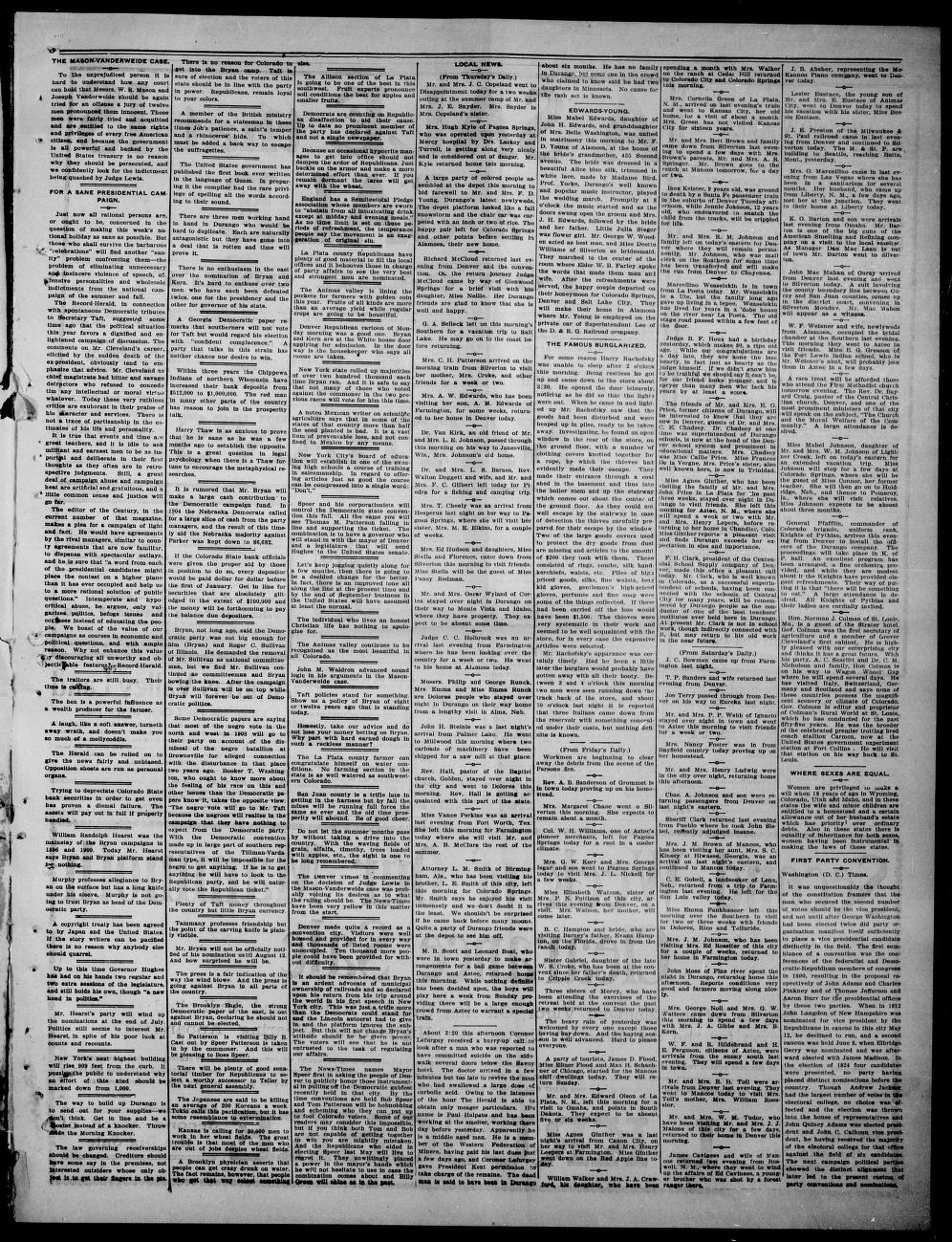
The first print mention we could find puts him in the winner's circle. At the September 1902 county fair, in the horse races, Jim Weaselskin won the half-mile, timed at :52, finishing ahead of a rider the paper recorded as Severo. (We don't assume that Severo is the Capote leader of the same name.) Utes were visible and celebrated in early Durango public life — even as that same 1902 article carries a racial slur we won't reproduce here.
“Mr. Weaselskin has an ingratiating smile and the blackest hair you ever saw.”
Durango Semi-Weekly Herald, March 4, 1909, p. 4 — quoted for its documentary and tonal record, condescension and all
“Jim Weaselskin, Mrs. Jim and the children”
By 1910 the record shows a whole family moving through ordinary allotment-era life:
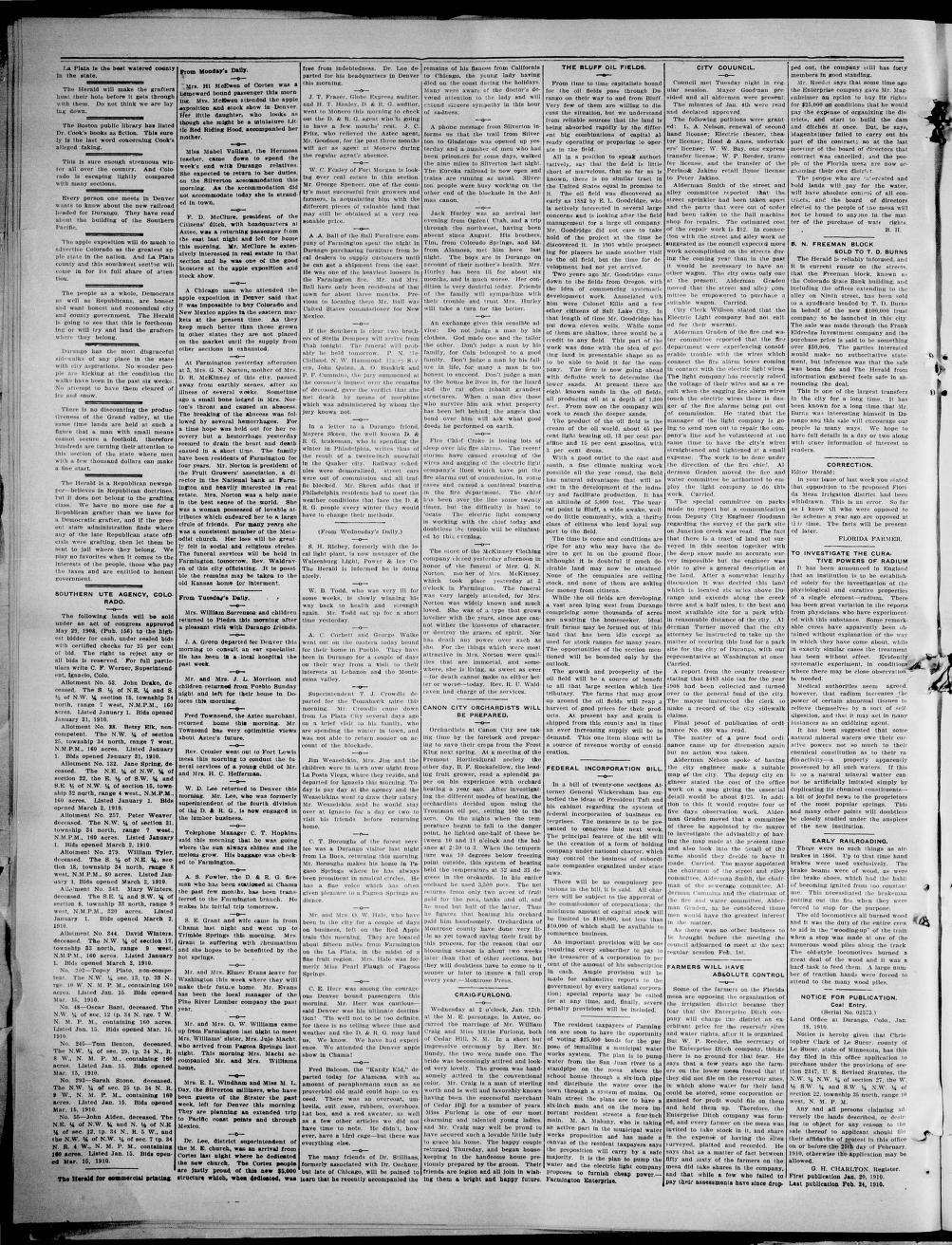
“Jim Weaselskin, Mrs. Jim and the children were in town over night from La Posta Viega, where they reside… Today is pay day at the agency and the Weaselskins went to draw their salary.”
Durango Semi-Weekly Herald, January 20, 1910, p. 4
The same page prints Southern Ute Agency allotment notices signed by the superintendent at Ignacio. A family, a home, a trip to the agency on pay day: the documented Weaselskin is a man of his own time and place, not a legend.
The story settlers told
In Dottie Warlick’s telling (Vallecito Country, 2003, p. 22), Weaselskin was born around 1850 and took his name from the weasel skins he wore. He summered his horses on Endlich Mesa, and Weasel Skin Creek is said to be named for him. He is supposed to have paid the Charlie Waldner family on the upper Florida River, and a Durango storekeeper, in raw gold nuggets — from a secret “Weaselskin Gold Mine” that no one ever found. In the same telling he died in the 1918 influenza on his allotment near Sunnyside Bridge, which was “later re-named 'Weaselskin Bridge' in his honor.”
No Ute-side version of this gold story exists anywhere we could find — not in the Southern Ute Drum, the Tribe's own histories, or the Doris Duke oral-history collections. The modern internet retellings all trace back to Warlick.
The “lost mine” has never been verified, and the country it's imagined in is Tribal Trust Land, Ute allotments, and the Weminuche Wilderness. Searching or digging for it there is illegal and does real harm. Please don't.
What the legend gets backwards
The gold story romanticizes a free-roaming figure crossing the high country at will. But the years it's set in — the 1900s and 1910s — were the years that freedom was being taken, allotment by allotment. The man the Waldners are said to have fed nuggets was a citizen of a nation whose mountains had been signed away in 1873 and whose reservation was being carved into parcels around him. The romance and the dispossession are the same story, told from opposite ends.
The Tuckerville connection
The legend is often credited with sparking the Cave Basin gold rush and the camp of Tuckerville up on Middle Mountain. But the documented 1913 strike there was copper and galena on the Dowell property, not a secret vein of gold — and the whole district's recorded lifetime gold output, about 120 ounces across a quarter-century, would fit in a coffee can. The dream the legend sold and the ore the mountain held were never the same thing.
The end, as tradition tells it
Local tradition holds that the 1918 influenza took Weaselskin at his allotment near the bridge that now carries his name. It’s plausible: he vanishes from the record around then, and the pandemic fell heavily on reservations. But no death record, and no county or state document renaming “Sunnyside Bridge” to “Weaselskin Bridge,” has been found.
The name lives
This is not a vanished name. The Southern Ute Tribe's own Animas fishing-access map marks “Weaselskin Bridge (East and West),” “La Posta,” and “Sunnyside Mesa” on Tribal Trust Land. The Southern Ute Drum uses “Weasel Skin Bridge” as a plain landmark in its reporting. And a Southern Ute family business, Weaselskin Land & Cultural Services, carries the name into the present day.
Sources: Southern Ute Indian Tribe (Animas fishing-access map; cited, not reproduced); the Southern Ute Drum.
Learn more from the Tribe
The best place to learn Ute history is from the Ute people. The Southern Ute Cultural Center & Museum in Ignacio tells that history in the Tribe's own voice.
- Southern Ute Cultural Center & Museum — 503 Ouray Dr, Ignacio, CO · southernutemuseum.org · (970) 563-9583
We warmly welcome review, correction, and contribution from the Southern Ute Indian Tribe and from any descendants of the Weaselskin family. Suggest a correction or reach us directly.
Sources & notes
Full source list, and what is held as unverified
Native sources first. Southern Ute Indian Tribe (tribal history; Animas fishing-access map — cited and linked, the Tribe, not republished here); the Southern Ute Drum.
Documented record: the Durango Semi-Weekly Herald, Sept. 29 1902 (p. 1), July 20 1908 (p. 3), March 4 1909 (p. 4), and Jan. 20 1910 (p. 4), via the Library of Congress / National Digital Newspaper Program (public domain); the U.S. Geographic Names Information System for Weasel Skin Creek and Weaselskin Bridge. The legend is drawn from a single printed source — Dottie Warlick, Vallecito Country (Western Reflections, 2003), p. 22 — and is labeled as settler tradition throughout.
Held as unverified: the honorific “Chief”; a birth year of 1850; the 1918 influenza death; the renaming of Sunnyside Bridge; Weaselskin's band; and whether “Marcellino” and “Jim” are one man or two.